
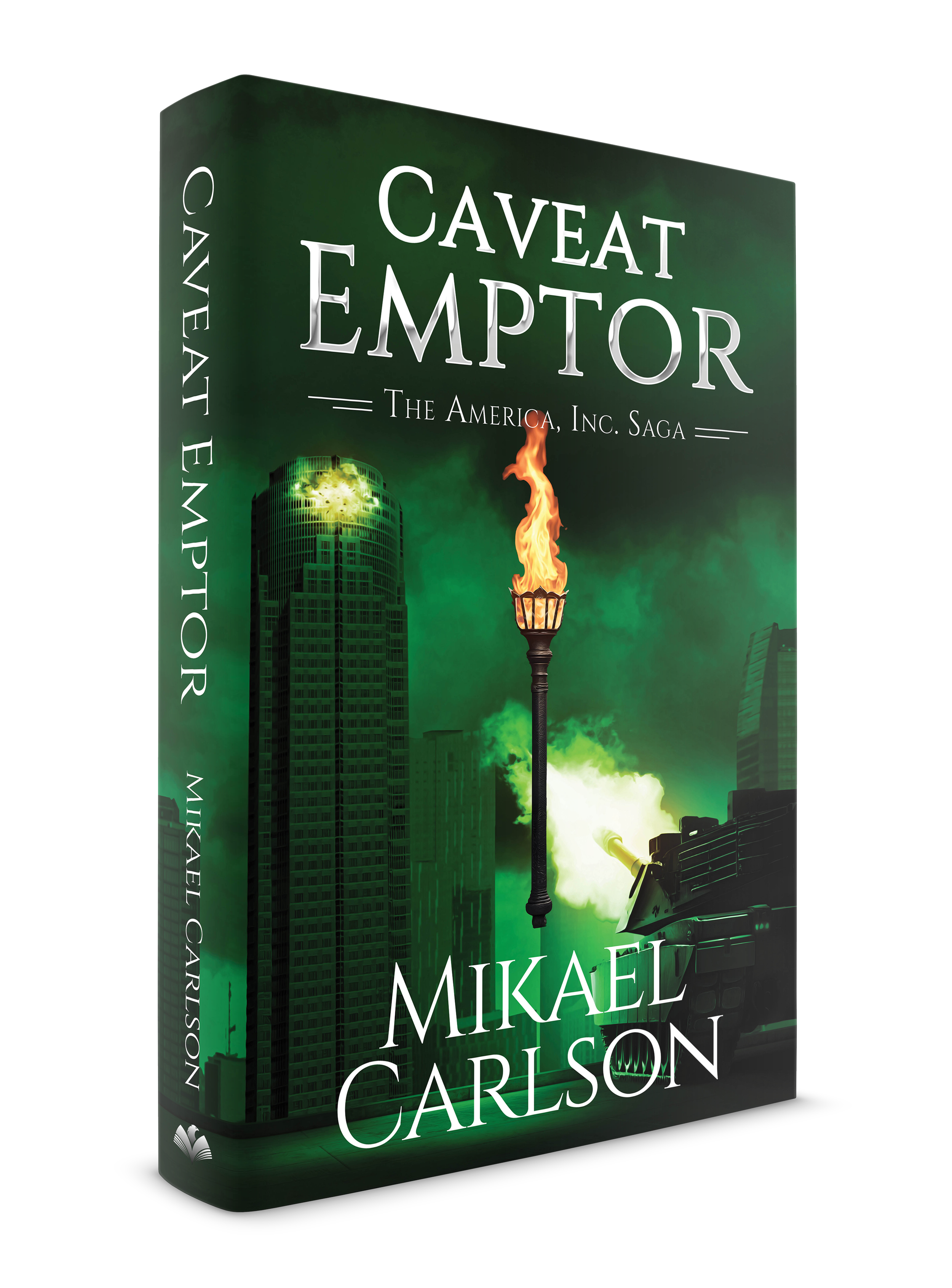
CAVEAT EMPTOR
THE AMERICA, INC. SAGA
BOOK 4
When you choose to trust someone…let the buyer beware.

Published by Warrington Publishing
View official publication details, editions, awards, ISBNs and retailer information by clicking the link below:
| Book Snapshot | |
|---|---|
| Series | America, Inc. Saga |
| Series Position | Book 4 |
| Genre | Dystopian Thriller / Political Thriller |
| Publication | March 11, 2025 |
| Author | Mikael Carlson |
| Publisher | Warrington Publishing |
| America, Inc. Saga — Reading Order | ||
|---|---|---|
| Book | Title | Status |
| 1 | The Black Swan Event | Available Now |
| 2 | Bounded Rationality | Available Now |
| 3 | Boiling the Ocean | Available Now |
| 4 | Caveat Emptor | Available Now |
| 5 | Zero Sum Game | Available Now |
| 6 | Paradigm Shift | Forthcoming |
AUDIOBOOK
Coming Soon!
Short Description
The corporate-controlled world is beginning to collapse. Attacks designed to create instability strike corporations around the globe while America Incorporated struggles to maintain control. Meanwhile, the surviving members of Liberteum have been betrayed, hunted, and pushed toward extinction.
To complete the Archimedes plan, the resistance must make one desperate final push—and it cannot succeed without new allies. The conflict ultimately moves toward a full-scale invasion of Manhattan that may decide the future of corporate rule.
Genre
Caveat Emptor combines dystopian fiction, political thriller, military thriller, action, conspiracy, and speculative fiction.
Of the first four America, Inc. novels, it places particularly strong emphasis on warfare, revolution, shifting alliances, and the survival of the resistance.
Inspiration
The novel is a question about trust: Who can you rely upon when everyone offering help wants something in return? Liberteum needs allies to survive, corporate leaders need cooperation to restore order, and the global elite are pursuing competing visions of the future. Every alliance creates an opportunity, but every alliance also carries a price.
I wanted to explore whether people with fundamentally different goals could cooperate long enough to defeat a common threat. Revolution may unite people against an enemy, but it does not erase their competing loyalties, political ambitions, or disagreements about what should replace the system they are fighting. As desperation grows, former enemies become necessary partners, loyalty becomes conditional, and betrayal can be justified as an act of survival.
At its heart, Caveat Emptor examines trust, sacrifice, authoritarian power, military force, and alliances of necessity. It also pushes the corporate world into a deeper crisis, reshaping the relationships among Liberteum, America Incorporated, Intercorpex, and the global elite. Those consequences create the political and military landscape of Zero Sum Game, where the cost of every bargain becomes impossible to ignore.
Behind the Book: Caveat Emptor
Caveat emptor means “let the buyer beware,” a fitting warning for a society in which nearly everything and everyone has a price and buying (or trusting) has consequences. Commerce and political power are inseparable in the world of America, Inc., so every bargain carries consequences beyond the transaction itself.
I wanted readers to question every agreement in the novel. The most attractive offer may also contain the greatest danger. Deals made earlier in the series begin coming due, and several characters discover that the true cost was hidden in the fine print.
The cold reunion between Farron and his father was intentional. Even before Denali reveals his intentions, the scene establishes that affection has little value in the Keating family when power is at stake.
I enjoyed writing Michele’s defiance in Denali’s study. She knows she has lost control of the situation, but she refuses to give him the satisfaction of seeing her submit.
I used the Meade Human Resources Center to turn familiar corporate language into something horrifying. “Processing” and “termination” have very literal meanings in America, Inc.
Fiolla’s interrogation scene forces her to confront the machinery she once helped administer. Her previous position in corporate affairs makes her imprisonment at Meade especially ironic.
The jug of urch shine in Ilaria’s apartment is more than a callback to the underground. It becomes proof that items dismissed by the corporate elite can unexpectedly affect the balance of power.
Denali watching simultaneous attacks unfold around the world is one of the darkest scenes in the series. To him, the casualties are not people; they are figures on a display confirming that his plan is working.
Modern military hardware isn’t a thing in this age, but old hardware is a different story. While there are no standing armies and navies in the Corporate Age, it doesn’t mean corporations don’t maintain small stockpiles of them. Thus, rolling out old M1 Abrams main battle tanks.
I am a believer that necessity is the mother of invention. You knew the qulis would devise some cool weapons given the skills of their various trades.
One of Murphy’s Laws of Combat states: Anything that can go wrong, will go wrong. Director Virtari learns that the hard way.
As AI continues to grow in both capability and popularity, Ortan’s system seems less far-fetched than it did when I envisioned this series.
The book brings several long-running schemes into the open while revealing that some apparent victories were carefully constructed traps.
The ending was designed to propel the series into Zero Sum Game, where compromise becomes increasingly difficult.
Frequently Asked Questions
-
Liberteum has suffered severe losses and is being hunted aggressively. The surviving resistance members have also been betrayed, making trust an especially dangerous commodity. Nevertheless, they remain determined to finish the revolutionary strategy they began earlier in the saga.
-
Extremely. Completing Archimedes becomes one of Liberteum's central objectives. The resistance has invested enormous sacrifices in the plan, and its surviving members believe finishing it may represent their final opportunity to prevent the corporate system from reasserting control.
-
New York has been central to the saga from the beginning. It is home to Intercorpex, a major center of America Incorporated's power, and the location of the underground society from which Liberteum operates.
By Caveat Emptor, the battle for Manhattan becomes symbolic of the larger fight over whether corporate authority can survive.
-
Yes. America Incorporated prepares a major assault involving military capabilities that have not been seen for decades. For corporate leadership, the invasion represents an attempt to restore control. For Liberteum, it becomes an existential struggle in which defeat could mean annihilation.
-
The Corporate Age largely eliminated conventional warfare between nations.
A return to large-scale military weapons therefore demonstrates how dramatically the crisis has escalated. The society that once boasted of eliminating war now finds itself employing the tools of war to preserve its own authority.
-
Their relationship finally moves beyond the unspoken attraction that developed in the earlier books. Rykos began as Michele's prisoner and gradually became someone she trusted, depended upon, and ultimately cared for far more deeply than she expected.
Their different backgrounds remain important. Michele was born underground and has spent her life fighting the corporate system, while Rykos grew up inside it. By Caveat Emptor, however, they are no longer on opposite sides. Rykos has embraced the struggle for freedom as his own.
-
It's a small scene with a larger meaning. After the termination center, Fiolla arrives in Valhalla emotionally shattered and stripped of almost every symbol of her former identity. Michele gives her underground clothing and braids her red hair in the style commonly worn there.
It isn't a formal initiation into Liberteum. It's something more personal: Michele is helping Fiolla feel human again and, symbolically, welcoming someone from the corporate world into hers.
-
Both men are outsiders in different ways. Zyree is an instinctive investigator whose refusal to ignore inconvenient facts ultimately isolates him. Ortan is a brilliant but socially awkward computer expert who has spent much of his life physically separated from other people.
Their friendship develops quickly because neither requires the other to pretend to be something he isn't. When Zyree is betrayed, Ortan is one of the people who refuses to abandon him.
-
Farron initially used his relationship with Fiolla for access and information, but somewhere along the way his feelings became genuine. By the time she is being held at the BCS termination center, saving her matters more to him than loyalty to his father, his position as a patrician, or his own safety. He recruits help, acquires an armed helicopter, and attacks one of the most dangerous security organizations in the world to get her out. It is probably the most convincing declaration of love Farron ever makes precisely because it isn't made with words.
Main Characters in Caveat Emptor
-

MICHELE
Leader of Liberteum
-

RYKOS
Registrant at Dinsmore Academy
-

ZEYKALA
Chief Executive Officer, America, Inc.
-

VIRTARI
Director of the Bureau of Corporate Security
-

DENALI KEATING
Patrician of the Gentez-Majorez
Books in The America, Inc. Saga
-

THE BLACK SWAN EVENT
BOOK 1
-

BOUNDED RATIONALITY
BOOK 2
-

BOILING THE OCEAN
BOOK 3
-
CAVEAT EMPTOR
BOOK 4
-
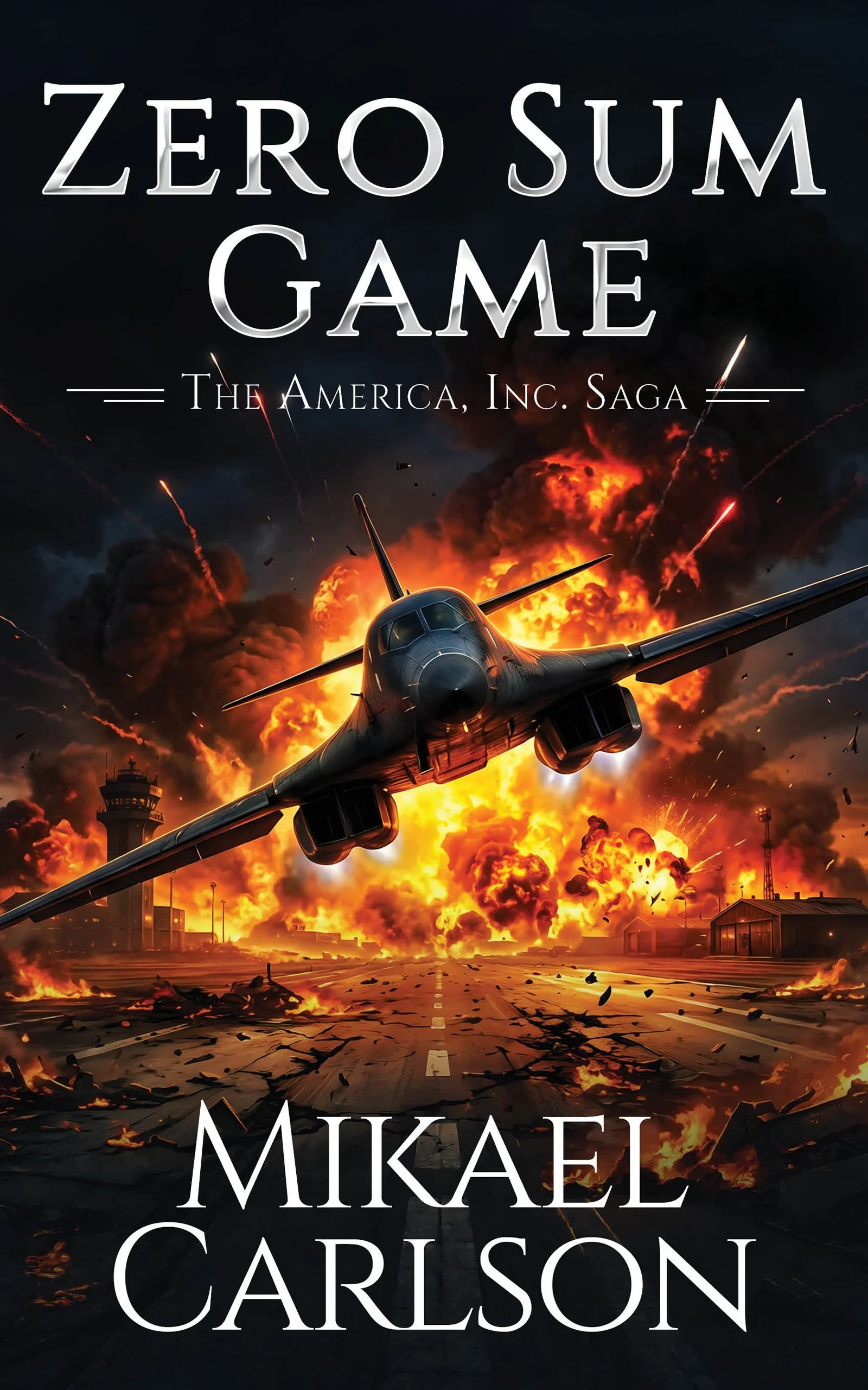
ZERO SUM GAME
BOOK 5